What Is a Birth Chart? The Frozen Sky at Your Birth Moment
A birth chart is a map of the real sky at the minute you were born, built from three facts: date, time, and place. Here is what each layer of the wheel shows.
If you’ve ever read your horoscope and thought “that’s not me at all,” you weren’t wrong. You were reading the wrong thing. A horoscope is a guess made for one twelfth of everyone on Earth. A birth chart is a snapshot of the real sky at the exact minute you were born, from the exact place you were born. Nobody guesses it. It’s calculated.
Strip away the mystery and a birth chart is a map. One frozen frame of the sky, drawn from three facts about you: the date you were born, the time you were born, and the place you were born. Everything on the wheel comes from those three inputs and nothing else.
The three layers of the wheel
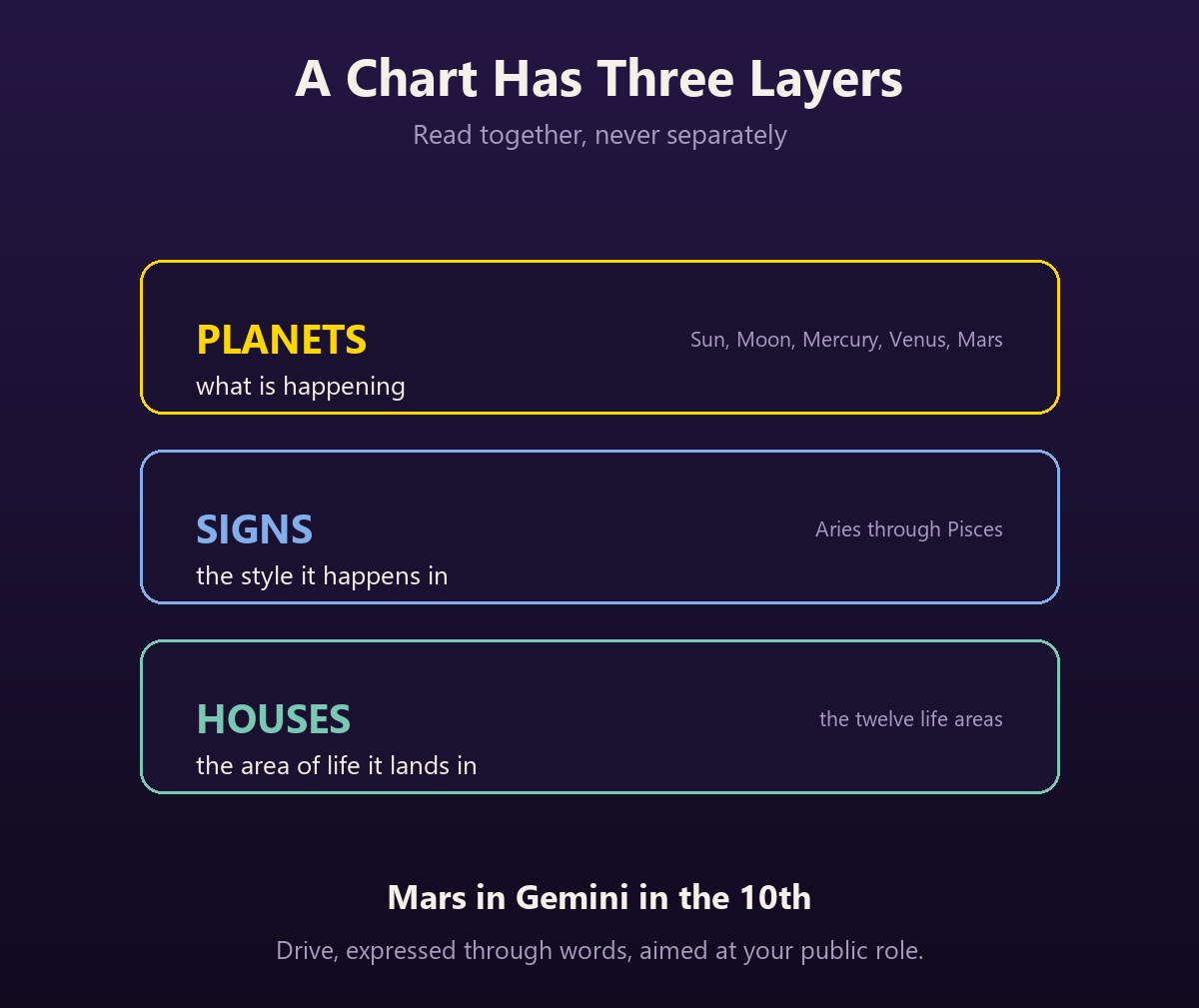
The map has three layers. If you can hold three layers in your head, you can read a chart.
Layer one: the signs
The wheel itself carries the twelve signs of the zodiac, arranged in a circle. Think of this as the background scenery. It never changes. Aries always sits next to Taurus, Taurus next to Gemini, all the way around. Every chart ever cast uses the same ring.
Layer two: the planets
At the moment you were born, every planet in our solar system, plus the Sun and the Moon, sat somewhere along that circle. Your chart pins each one where it was. When someone says “my Sun is in Pisces,” they mean one thing: at the minute they were born, the Sun sat in the Pisces section of the sky. Nothing more mysterious than that.
Layer three: the houses
This is the layer almost no horoscope ever mentions. The houses slice the wheel into twelve sections, but instead of personality, each one stands for an area of life: money, home, relationships, career, and so on. Your birth time and birth place set where the houses fall, and they’re the reason two people born on the same day can have genuinely different charts. Same planets, different houses, different life map.
Why your horoscope never quite fit
Hold that map against a daily horoscope. The horoscope uses one of those data points: the Sun. Not the Moon, not the houses, not a single other planet. Just the Sun’s sign, which you share with roughly one out of every twelve people alive. Hundreds of millions of people get the same forecast as you, every day.
So when a column says “Pisces, today is a day for bold moves,” it isn’t lying to you. It’s working with almost no information. It’s like describing your whole personality from the first letter of your name.
Your birth chart is the opposite. It uses your full date, your time down to the minute, and your city. Run the same calculation for someone born the same day as you but three hours later, or one state over, and the chart changes. The Moon may have moved into a different sign. The houses have definitely rotated. No two charts match, because no two people were born at the same instant in the same place.
The difference in one sentence: a horoscope describes your twelfth of the population. A chart describes you.
Where the frozen frame comes from
“Frozen sky” isn’t a metaphor. The sky moves on two clocks at once. The planets creep along the zodiac at their own speeds, from the Moon crossing a sign in about two and a half days to the outer planets taking years. And the whole sky appears to wheel overhead once a day as the Earth turns, which is what makes your birth place matter as much as your birth date.
A birth chart stops both clocks at your first minute. The slow clock fixes which sign each planet occupies. The fast clock fixes which sign was climbing the eastern horizon from your birthplace, and with it the entire house layout. That’s why the chart asks for a place and not just a date: two babies born at the same minute in Chicago and in Lisbon share the same planets but look up at different horizons, so their houses fall differently. The math behind all of this is worth a post of its own, and we’ve written one on how birth charts are calculated.
A real chart, read start to finish
Make it concrete with an example. Meet Maya, born March 14th, 1992, at 6:42 in the morning, in Chicago. Three facts. Here’s what her chart shows.
First, the Sun. Its symbol on the wheel is a circle with a dot in the middle, and in Maya’s chart it sits in Pisces. On March 14th it always does. This is the one piece of her chart any horoscope column already knew.
Next, the Moon, the crescent symbol. In Maya’s chart it sits in a completely different sign than her Sun. The Moon changes signs roughly every two and a half days, so this placement is already far more specific to her than her Sun sign ever was. Astrology reads the Moon as the emotional layer: how you feel, not how you present.
Third, the rising sign, also called the Ascendant. This one isn’t a planet at all. It’s the sign that was coming up over the eastern horizon at 6:42 AM in Chicago, the minute and place she was born. Shift her birth by two hours and it’s probably a different sign entirely. The rising sign sets where house number one begins, which means it arranges her whole house wheel. It’s the most personal, most time-sensitive point on the map. We’ve written a full guide to what your rising sign says about you.
One note on missing data. If Maya didn’t know her birth time, her chart would still work. The Sun, the Moon, and the planets all still land in their signs. What she’d lose is the houses and the rising sign, because those need the clock and the map. A well-cast chart fills in nothing fake. It shows what the data supports and says so.
Three facts you already own
Everything above came from a date, a time, and a place. If you know yours, you already hold everything a professional astrologer would need to cast your full chart. Most people carry those three facts their whole lives and never once see the wheel drawn from them.
You can see yours in MysticAlmanac: enter your birth details and it casts the full wheel, then walks you through it one placement at a time, in plain language.
What a chart is for
A birth chart isn’t a script for your future. Read it as a mirror: a map of tendencies, patterns, and themes you can recognize yourself in and work with. What you do with what you see in it is entirely yours.
Where to go next
Start with the three placements that carry the most personal weight: your Sun, your Moon, and your rising sign. Together they’re called your Big Three, and they’re the fastest route from “I know my sign” to “I can read my chart.” From there, the houses and the aspects between planets fill in the rest of the picture. If you’d rather take the whole ladder in order, in one sitting, that’s the full birth chart course.
The whole idea in three lines. A birth chart is a calculated snapshot of the real sky at your birth moment. It has three layers: signs, planets, and houses. And it’s built from your date, time, and place, which is why it’s yours alone, and why a one-size-fits-twelve horoscope never sounded like you.
Common questions
What is a birth chart?
A birth chart, also called a natal chart, is a calculated snapshot of the sky at the exact minute and place you were born. It records where the Sun, the Moon, and every planet sat along the zodiac, plus the twelve houses set by your birth time and location.
What do I need to calculate my birth chart?
Three facts: your birth date, your exact birth time, and your birth place. Date alone still places the Sun, Moon, and planets in their signs. The houses and the rising sign need the time and place.
How is a birth chart different from a horoscope?
A daily horoscope uses one data point, your sun sign, which you share with roughly a twelfth of everyone alive. A birth chart uses your full birth data, so no two charts are the same unless two people were born at the same instant in the same place.
Cast your birth chart
Your date, time, and place, run through a real ephemeris — the full wheel, every placement named and explained in plain language. Seven days free at full Premium.
Cast my chart free →Not ready for that? New lessons go up daily — subscribe on YouTube or follow on TikTok.