Your Big Three: Sun, Moon, and Rising Signs Explained
Your Sun, Moon, and Rising sign each govern a different layer of you. Learn what your Big Three means and how to find all three on your own birth chart.
Everyone knows their sun sign. Almost nobody checks their moon or rising, and that is usually why a horoscope feels wrong. Those three placements together are your Big Three: your Sun, your Moon, and your Rising sign. Each one governs a different layer of who you are, and reading all three tells you more than any single one ever could. This guide covers what each placement means and exactly where to find all three on your own chart.
Your Sun sign: core identity
Start with the one you already know. Your Sun sign is the sign the Sun was sitting in on the day you were born. It is the placement every horoscope column uses, and for most people, the only one they ever learn.
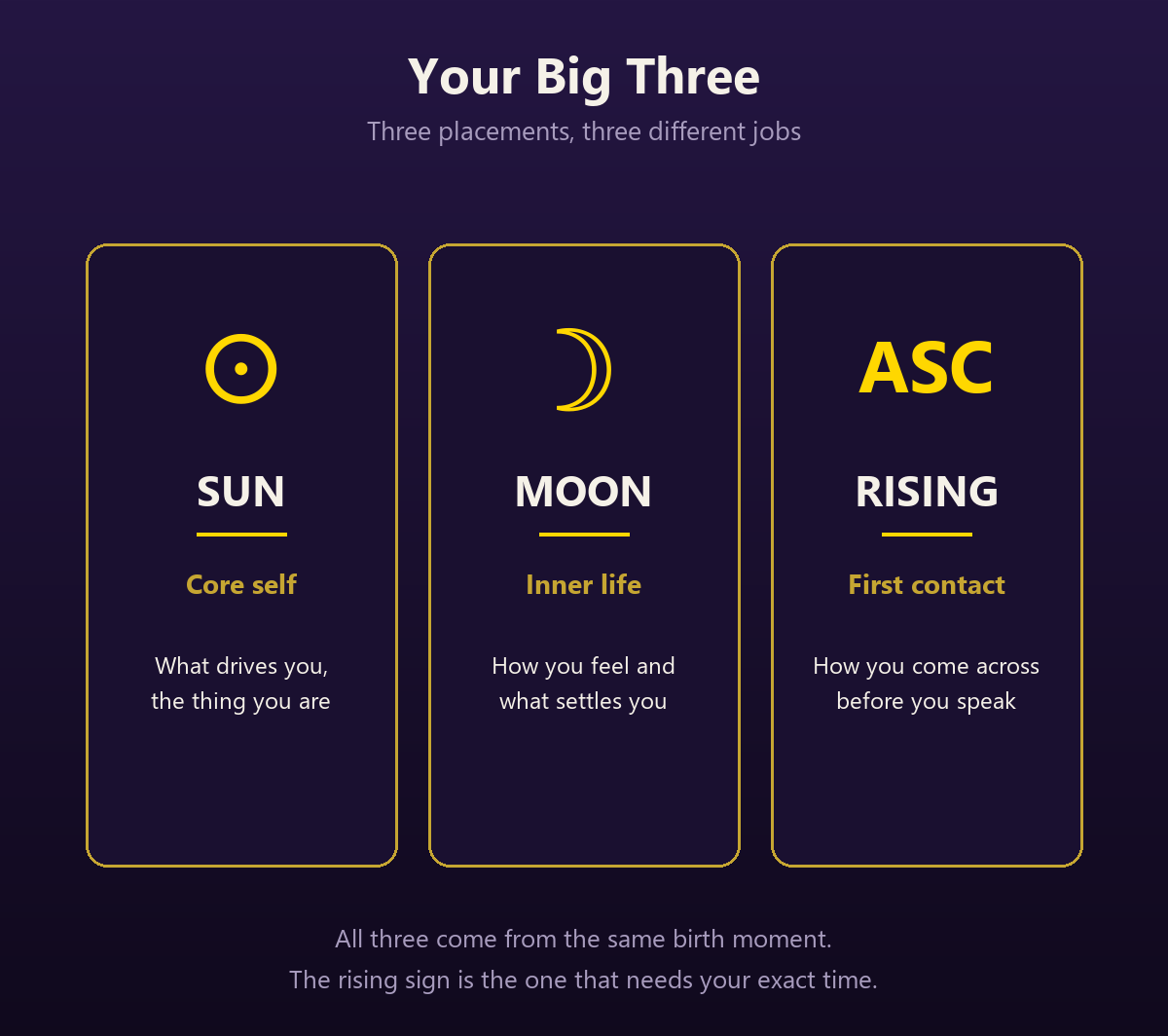
In astrology, the Sun is read as your core identity: your basic sense of self, what drives you, the “you” underneath everything else. It is not your whole personality. It is more like the headline, the part of you that stays recognizably you no matter what room you walk into. The Sun holds still in one sign for about a month at a time, which is why an entire month of birthdays shares the same one.
Your Moon sign: the emotional layer
Your Moon sign is the placement almost nobody checks, and it is often the real reason a Sun-sign horoscope feels off.
The Moon moves fast. It changes signs roughly every two and a half days, so unlike your Sun, your Moon sign is specific to your exact birthday, not your birth season. Even twins born hours apart can end up with different Moons, because it can shift signs in the middle of a single day.
In astrology, the Moon is read as your emotional layer: how you feel underneath the surface, what makes you feel safe, how you react before you’ve had time to think. If the Sun is who you are on the outside, the Moon is what’s happening on the inside. Two people can share the same Sun sign and have completely different Moons, one steady and even-keeled, one intense and quick to react. That difference alone can make two “identical” horoscopes describe two very different people.
Your Rising sign: the first impression
The third piece is your Rising sign, also called your Ascendant, and it isn’t a planet at all. It is the zodiac sign that was coming up over the eastern horizon at the exact minute and place you were born. Because the sky rotates once a day, your Rising sign depends on your birth time down to the minute. Shift it by two hours and it is often a completely different sign.
The Rising sign is read as your first impression: the style and instinctive approach people notice about you before they get to know you. It also sets the starting point for your entire house wheel, which makes it the most time-sensitive placement of the three, and the one every horoscope skips, because a horoscope never asks what time you were born.
There is more to the Ascendant than one paragraph can carry. The full picture is in what your rising sign really says about you.
Why one sign was never going to be enough
Here is the math. There are twelve possible Sun signs, twelve possible Moon signs, and twelve possible Rising signs. Multiply those together and you get 1,728 possible Big Three combinations, before a single house or aspect even enters the picture.
Your Sun sign alone puts you in a room with roughly one out of every twelve people alive. Same core identity theme, completely different emotional world, completely different way of coming across. Your full Big Three narrows that down to a small, specific group. That is the gap between “my horoscope never quite fits” and “okay, that’s me.” It was never that horoscopes are fake, exactly. They were only ever reading a third of your chart.
So which one is the “real” you? None of them on their own. They are not competing for the same job. Your Sun describes your core identity, your Moon your inner emotional world, your Rising your outward first impression. Asking which one is really you is like asking whether a photograph’s subject, lighting, or framing is the real picture. All three are doing different work on the same image.
A real chart, all three together
Meet Maya, born March 14th, 1992, at 6:42 in the morning, in Chicago.
Her Sun sits at 24 degrees Pisces, so her core identity theme is Pisces: imaginative, absorbing, tuned in to feeling before fact. That is the one placement any horoscope column already knew about her.
Her Moon sits at 25 degrees Cancer. Cancer happens to be the Moon’s own sign, the one it is considered most naturally at home in, which makes this an especially strong placement for her. A Cancer Moon tends to process the world through memory, home, and the people closest to it, a noticeably different flavor from her dreamy Pisces Sun.
Her Rising sign is 9 degrees Aries: direct, fast-moving, quick to act. On a first meeting, Maya can come across as decisive and energetic, even though underneath that Aries Rising her core identity runs gentle and imaginative, and her emotional world runs quiet and protective. Three placements, three different signs, one person. That is exactly why “she’s a Pisces” was never going to be the whole story on Maya.
If you know your birth date, time, and place, you already have everything needed to lay out your own three the same way. A cast chart in MysticAlmanac places all three from your exact birth details and walks you through each one in plain language.
How to find your Big Three on the wheel
Most charts show these placements two ways: on the wheel itself, and in a written list nearby where the same signs are spelled out in text. If a glyph is hard to pick out at first, the list has the same answer in plain words.
Find your Sun
Look for a circle with a dot in the center. That is the Sun’s glyph, and whichever sign it sits in is your Sun sign. Next to it you will usually see a small number: the degree within the sign, useful later but nothing you need to note yet.
Find your Moon
Look for a thin crescent symbol and note its sign. Check whether it matches or clashes with your Sun. Most people’s Sun and Moon land in different signs, and either answer is useful information, not a verdict.
Find your Rising
This one is the hardest to spot, because there is no glyph to hunt for. Your Rising sign sits wherever the wheel’s leftmost horizon line falls, usually labeled ASC or Ascendant. If your chart shows a Rising sign, you entered a birth time. If it is blank or says unknown, your Sun and Moon are still fully yours either way.
What to do with all three
Search each placement by its full name instead of your birthday alone: Pisces Sun, Cancer Moon, Aries Rising. Order doesn’t matter. Notice how much more specific that description feels than one blurry horoscope paragraph ever did. Three separate answers standing in for the one that was never quite right.
If your Sun and Moon seem to want opposite things, that tension has a guide of its own: Sun sign vs Moon sign. From here, the next step is sorting these placements into houses, the life areas of the chart. If you want the ground floor first, start with what a birth chart actually is, then come back and find your three. Or take every rung in order in a single sitting with the full birth chart course.
Common questions
What is the Big Three in astrology?
Your Big Three is your Sun sign, Moon sign, and Rising sign. The Sun is read as your core identity, the Moon as your emotional layer, and the Rising sign as the first impression you make. Together they describe you far more specifically than a Sun sign alone.
How do I find my Sun, Moon, and Rising sign?
You need your birth date, exact birth time, and birth place. A cast chart shows the Sun as a circle with a dot in the center, the Moon as a crescent, and the Rising sign at the wheel's left-hand horizon line, usually labeled ASC or Ascendant.
Can I know my Big Three without a birth time?
Partly. Your Sun sign only needs your birth date, and your Moon sign is usually knowable from date and place. The Rising sign changes about every two hours, so it needs your exact birth time to be accurate.
Find your Big Three
Your Sun, Moon, and rising sign placed from your exact birth details, each one explained in plain language rather than left as a label. Seven days free at full Premium.
Find my Big Three →Not ready for that? New lessons go up daily — subscribe on YouTube or follow on TikTok.