How Are Birth Charts Calculated? The Real Math Explained
How a birth chart is calculated: Swiss Ephemeris data, why your exact birth time and place change the result, and why two astrology sites can disagree.
Type a birth date into a chart calculator and a full wheel comes back in about a second. It looks like magic, so it’s fair to ask what happens inside. The answer to how birth charts are calculated is astronomy: every planet position in a real chart comes from orbital math, the same kind astronomers use to track planets across the sky. Here is the whole pipeline, from the three facts you type in to the wheel on your screen, and why two websites can hand you charts that don’t quite match.
What an ephemeris is
Every planet in the solar system moves along a path set by gravity, one that can be computed for any date. It’s the same physics that lets scientists calculate exactly where a spacecraft will be years from now. An ephemeris is a giant, precomputed table built from that math: where every planet was, at any date, going back centuries. It isn’t a tradition or an opinion. It’s math, checked against real telescope observations.
The specific dataset behind an accurate chart is called the Swiss Ephemeris, and it’s the engine most professional astrology software runs on. Each sign of the zodiac spans exactly 30 degrees, and the ephemeris returns a precise number inside that span, down to the minute of a degree, for wherever a planet sat. A placement like “24 degrees of Pisces” isn’t a guess. It’s a coordinate.
This math gets tested against reality constantly. The same kind of calculation calls real solar and lunar eclipses to the minute, sometimes decades ahead, and astronomers then watch them happen on schedule. A birth chart uses that identical toolkit, pointed at a date in the past instead of the future.
One more piece of translation while we’re here. The zodiac isn’t a mystical belt. It’s the band of sky that the Sun, the Moon, and every planet all appear to travel through, from Earth’s point of view, sliced into twelve familiar signs. When the ephemeris says a planet is “in Pisces,” it’s naming which twelfth of that band the planet was crossing at the time.
Before computers, astrologers ran this same calculation by hand, with printed tables and careful arithmetic. Software didn’t change what a chart is. It made an afternoon’s work instant.
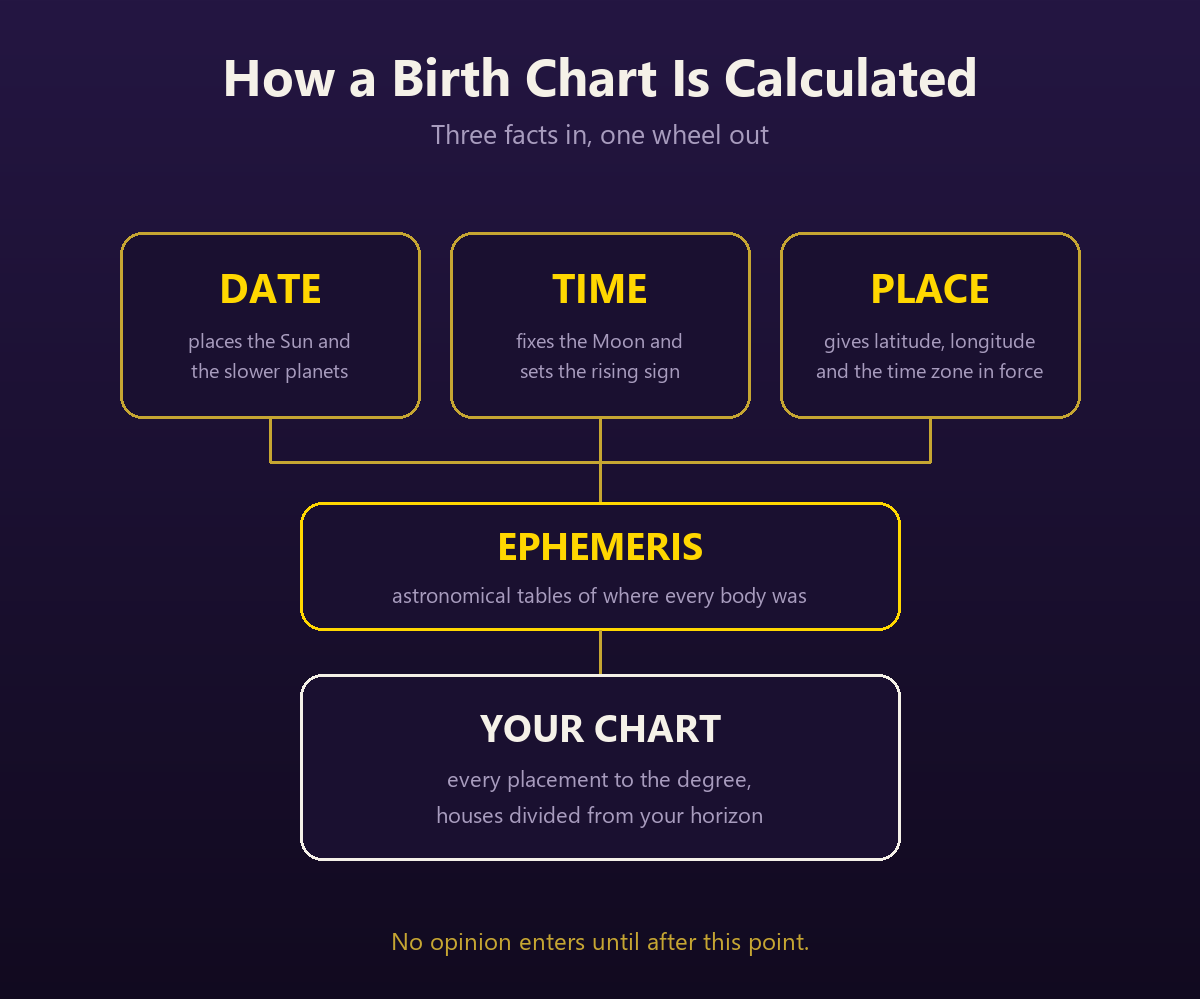
Step one: date and time place the planets
Feed in a date and a time, and the ephemeris returns exactly where the Sun, the Moon, and every other planet sat along the zodiac at that minute.
Precision matters here because every planet moves at its own pace. The Moon crosses the entire zodiac in about a month, shifting roughly half a degree every hour, so its sign can change within a single day. Saturn takes almost thirty years to make the same trip, which is why two people born years apart can still share a Saturn sign. An ephemeris tracks all of it, planet by planet, without mixing up one pace for another.
But date and time only get you the planets. They don’t get you the houses, and they don’t get you the rising sign. For those, the calculation needs a third fact: exactly where on Earth you were born.
Step two: place sets the Ascendant and the houses
The Earth spins once roughly every twenty-four hours, and that spin makes the whole sky appear to rotate around you over the course of a day. At the minute you were born, one specific point of the zodiac sat right on the eastern horizon, about to rise. That point is the Ascendant, the starting line for house number one.
From there, the calculation slices the rest of the sky into twelve houses using a set of rules called a house system. One long-established method is Placidus, which divides the space between the horizon and the point directly overhead into twelve sections. Other house systems exist. Serious software picks one and stays consistent about it.
The same math produces one more point: the Midheaven, the spot directly overhead at your birth moment, traditionally read as career and public reputation. The Ascendant and the Midheaven are the two chart points that come purely from location and clock time rather than from any single planet.
There’s a fourth layer, the lines connecting planets to each other, called aspects. That’s its own topic. For now, the pipeline reads: date and time place the planets. Time and place together set the Ascendant, the Midheaven, and the houses around them.
The whole pipeline on one real chart
Take Maya, born March 14th, 1992, at 6:42 in the morning, in Chicago.
Step one, the date and time go in. The ephemeris returns every planet’s position for that minute, which is how we know her Sun landed at 24 degrees of Pisces and her Moon at 25 degrees of Cancer. Those numbers came from an orbital calculation, not a printed table of zodiac dates.
Step two, the place goes in: Chicago, at its exact coordinates. Combined with her birth time, that put her Ascendant at 9 degrees of Aries, the sign rising over Chicago’s eastern horizon at 6:42 that morning.
Step three, the house system takes that Ascendant and divides the rest of the sky around it, dropping each planet into a specific house and placing her Midheaven at 4 degrees of Capricorn, her career point.
None of it came from a birth-date lookup chart. Every number was calculated fresh for her exact date, time, and place, and someone born even one state over would see the numbers shift. If you want to watch this happen with your own three facts, MysticAlmanac runs this same Swiss Ephemeris pipeline live, so the wheel you get is computed for your birth, not looked up from a table.
Why two sites can show you different charts
Here’s a reassuring fact: for the same birth data, any two pieces of serious astrology software land on the same planetary positions. The math underneath is shared, so the planets agree. When charts disagree, the difference nearly always traces to one of two inputs.
The first is the house system. Different sites default to different methods of dividing the sky, so the same Ascendant can sit at the head of houses drawn differently. Neither chart is broken. They’re answering the same question with a different set of dividing rules, which is why consistent software declares its method and sticks with it.
The second is the birth time itself. An hour’s difference can move the Moon enough to matter, and it swings the Ascendant and every house with it. A time typed as 6:42 on one site and rounded to 7:00 on another is enough to produce two visibly different wheels. When charts conflict, check the entered time before doubting the math.
What you can and can’t get without a birth time
A chart asks for your exact birth time and location because of how the math works, not because of any rule. Without a birth time, an ephemeris can still hand you your Sun and your Moon, since those don’t depend on where on Earth you were standing. The Ascendant, the Midheaven, and the houses can’t be calculated without it, because they come from the Earth’s rotation under your specific spot on the map.
So the short version: a real chart starts with your date and time, run through the ephemeris, and that places your planets. Your time and place together add the Ascendant, the Midheaven, and the houses. Every part of it is a genuine calculation, the same one astrologers once did by hand. What a placement means for your life is a separate question, built on top of the astronomy, and it’s the question the rest of this series takes up, starting with what a birth chart is and the houses your planets fall into. The full birth chart course runs the whole sequence in order if you’d rather take it in one pass.
Common questions
What is the Swiss Ephemeris?
The Swiss Ephemeris is a precomputed dataset of planetary positions, built from the same orbital math astronomers use. It's the calculation engine behind most professional astrology software, returning each planet's position down to the minute of a degree for any date.
Why does my exact birth time matter for a birth chart?
The Moon moves roughly half a degree every hour, so even an hour's error can shift it. More than that, the Ascendant, the Midheaven, and all twelve houses come from the Earth's rotation at your exact time and place. Without a birth time, only your planets can be placed.
Why do two astrology websites show me different charts?
For the same birth data, serious software lands on the same planetary positions. Differences almost always come from the house system used to divide the chart, or from a birth time entered slightly differently. Check both before assuming one site is wrong.
Run the calculation on your own data
The same ephemeris maths described above, applied to your birth date, time, and place, with every placement shown to the degree. Seven days free at full Premium.
Calculate my chart →Not ready for that? New lessons go up daily — subscribe on YouTube or follow on TikTok.