Birth Chart Aspects: The 5 Majors, Orbs & How to Read Them
What birth chart aspects are, how the five major aspects and orbs work, and a simple subtraction method for reading the aspect list in your own chart.
If you have ever looked at a birth chart and seen a tangle of lines crisscrossing the middle, that isn’t decoration. Those lines are birth chart aspects: the angles between your planets, measured around the wheel. And they carry as much weight as any single placement, because a chart isn’t really a list of positions. It’s a set of relationships, and the aspects are where those relationships live.
This guide covers what an aspect is, the five major aspects and what each one means, how orbs work, and a method for reading the aspect list in your own chart with nothing more than subtraction.
What an aspect is
Every placement in your chart sits at an exact degree somewhere on the 360-degree wheel: the Sun, the Moon, the planets, even the ascendant. An aspect is simply the angle between two of those points, measured along the circle.
Certain angles keep repeating across every chart ever cast, because they divide the circle evenly. Each of those angles gets its own name and its own meaning.
The five major aspects
Astrologers work with five major aspects. Four of them show up constantly; the fifth, the sextile, appears in most aspect grids too.
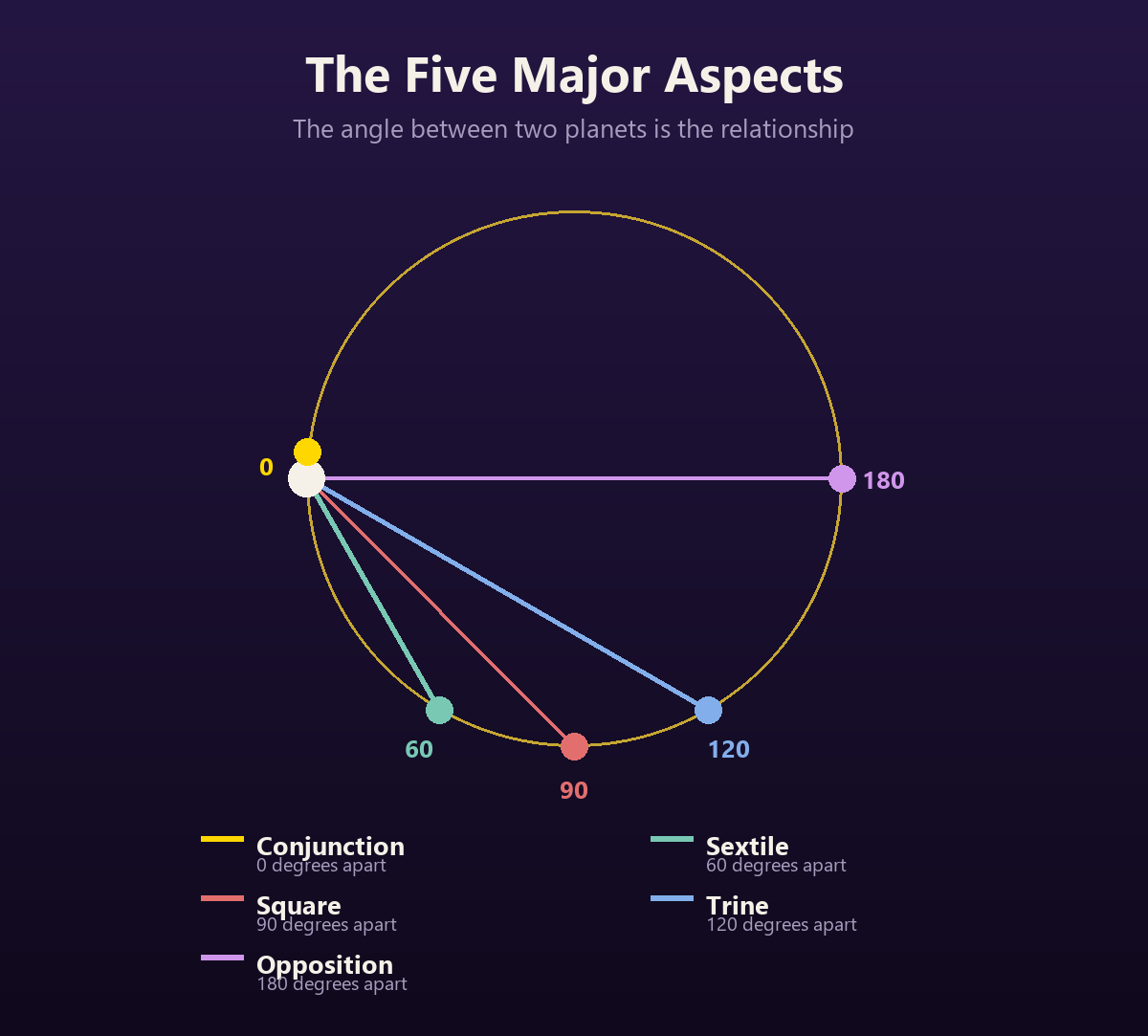
Conjunction (0°)
Two points sitting right on top of each other, blending together. Whatever those two planets represent, they operate as one combined thing rather than two separate ones.
Sextile (60°)
One sixth of the wheel apart. Like the trine, the sextile reads as ease and cooperation, but a gentler version: an opportunity that responds well when you put a little effort behind it.
Square (90°)
A quarter of the wheel apart. The square reads as friction, something that asks for active work between the two placements involved.
Trine (120°)
A third of the wheel apart. The trine reads as ease: two placements that cooperate without much effort from you.
Opposition (180°)
Straight across the wheel. Two points pulling toward opposite ends of the same theme, a genuine tug-of-war that asks for balance.
”Hard” and “soft” aspects: a mix-up worth clearing up
Squares and oppositions get called “hard” aspects and treated like bad news. Trines and sextiles get called “soft” and treated like good news. That’s an oversimplification.
A square is friction, and the friction is real. But friction is also where growth happens: a square is the aspect most likely to point at something you’re actively working on. A trine is ease, and ease can just as easily mean a talent you never bothered to develop, because it never asked anything of you.
Neither is a verdict. They’re two different textures of relationship between two parts of your chart. Read your aspects for texture, not for a grade.
Orbs: how close counts as exact
Almost no aspect lands on a perfectly exact angle. Astrologers allow a few degrees of wiggle room either side of the exact number, and that margin is called the orb. A trine at 118 degrees still counts as a trine. The tighter the orb, the stronger the aspect is considered to be, so a trine less than 2 degrees from exact reads louder than one that’s 7 degrees off.
Four aspects on a real chart
Here’s the whole thing in practice, using a sample chart we’ll call Maya’s.
A conjunction. Her Mercury sits at 10 degrees Aries, and her ascendant sits at 9 degrees Aries. Subtract one from the other and they land under 2 degrees apart, about as tight a conjunction as you’ll ever see. Mercury is the planet of thinking and talking; the ascendant colors first impressions. Put them together and quick, verbal curiosity is baked into how Maya comes across before she says a word.
A trine. Her Sun sits at 24 degrees Pisces, her Moon at 25 degrees Cancer. Run the same subtraction around the wheel and the gap lands under 2 degrees off an exact 120. Her identity (the Sun) and her emotional layer (the Moon) work with each other rather than against each other.
A square. Her Mars sits at 19 degrees Aquarius, her Pluto at 22 degrees Scorpio, about 3 degrees off an exact 90. Mars is drive and assertion; Pluto is intensity and transformation. A square between them describes the kind of drive you have to actively channel rather than something that shows up on its own.
An opposition. Her Venus sits at 0 degrees Pisces, her Jupiter at 7 degrees Virgo, about 7 degrees off an exact 180. Venus is what you value and enjoy; Jupiter is expansion and excess. The opposition describes a pull between two ends of one theme: enough is enough, versus more is more.
The method underneath all four is the same: pick two placements, subtract the smaller degree total from the larger, and see how close the result lands to 0, 60, 90, 120, or 180. Everything else is interpretation layered on top of arithmetic anyone can check.
If working that math by hand isn’t how you’d rather spend your evening, MysticAlmanac calculates your full aspect list from your exact birth details and walks you through the tightest ones first.
Reading your own aspect list: the grid
Most properly cast charts come with an aspect grid: a small triangle table with every planet listed along both edges. Where a row and a column meet, if those two planets form a major aspect, the cell gets filled with a small symbol. Empty cell, no major aspect there. Filled cell, a relationship worth reading. You’re scanning a table for filled boxes.
Start with the tightest orbs. A conjunction under 2 degrees says more about you than an opposition at 7, so read your closest aspects first and let the wide ones stay background.
Patterns: when three points connect
One thing a grid never shows you if you only check a single cell at a time: patterns that span three points, not two.
Back to Maya. Her Sun and Moon trine each other. But her Moon (25 degrees Cancer) also sits within about 3 degrees of a trine to her Pluto (22 degrees Scorpio). Check the third side, Sun to Pluto, and it comes in under a degree and a half off 120. All three sides check out. Sun, Moon, and Pluto close a full triangle across the wheel, and astrologers call that a Grand Trine.
Look at what connects them: Pisces, Cancer, and Scorpio are all water signs. Her identity, her emotional world, and her capacity for deep change aren’t just individually at ease with each other. They’re locked into one continuous loop of it.
Grand Trines aren’t common; most charts don’t have one at all. So when you open your own grid, don’t stop at the first filled cell. Pick one planet and check whether it makes the same aspect to two other planets at once. If it does, you may have a triangle of your own. If not, that’s completely normal, and a chart without one isn’t missing anything. It’s just built differently.
Where aspects fit in the bigger picture
Aspects are the last definitional layer of chart reading. Your Big Three tell you who. Your houses tell you where. Your aspects tell you how the pieces talk to each other, sometimes two at a time and sometimes three at once. Read together, the wheel stops being a list and becomes one connected picture.
That’s the top of the ladder. If you climbed to it out of order, the full birth chart course runs every rung in sequence, ending with three step-by-step passes through your own chart.
Common questions
What are aspects in a birth chart?
Aspects are the angles between two points in your chart, measured along the 360-degree wheel. Certain angles repeat across every chart because they divide the circle evenly: the conjunction (0°), sextile (60°), square (90°), trine (120°), and opposition (180°). Each describes a different kind of relationship between two placements.
What is an orb in astrology?
An orb is the wiggle room astrologers allow around an aspect's exact angle. Almost no aspect lands perfectly on 0, 60, 90, 120, or 180 degrees, so a few degrees either side still counts. The tighter the orb, the stronger the aspect is considered to be.
Are squares and oppositions bad aspects?
No. Squares and oppositions describe friction and tension, and friction is where growth tends to happen. Trines and sextiles describe ease, but ease can also mean a talent left undeveloped. Neither kind is a verdict; they are different textures of relationship between two parts of your chart.
See your own aspect grid
Every major aspect in your chart, found and ranked by exactness, so you know which lines to read first instead of guessing. Seven days free at full Premium.
Show my aspects →Not ready for that? New lessons go up daily — subscribe on YouTube or follow on TikTok.