All 12 Birth Chart Houses Explained (and How to Find Yours)
What each of the 12 houses in your birth chart means, in plain language, plus a simple step-by-step method for finding which house every planet sits in.
Most people learn their sun sign, maybe their Big Three, and stop there. The birth chart houses are the layer that turns those placements into something specific to your life. A sign describes how a planet behaves. A house describes where that behavior shows up: money, home, work, partnership, the private corners nobody sees. This guide walks through all twelve, then shows you exactly how to find which house each of your planets is sitting in.
What a house is
A house is one of twelve wedges your chart gets sliced into. Unlike a sign, a house isn’t about personality. It’s a life area. Houses come from your exact birth time and place, which makes them the most personal layer of the whole chart: a sign can hold for weeks, but a house cusp (the line where one house ends and the next begins) can shift within minutes. Two people born the same day in the same city, one in the morning and one that night, can share every sign placement and still live those placements out in completely different areas of life.
House 1 always starts at your Ascendant, the rising sign point on the eastern horizon. From there the other eleven fall into place in order around the wheel.
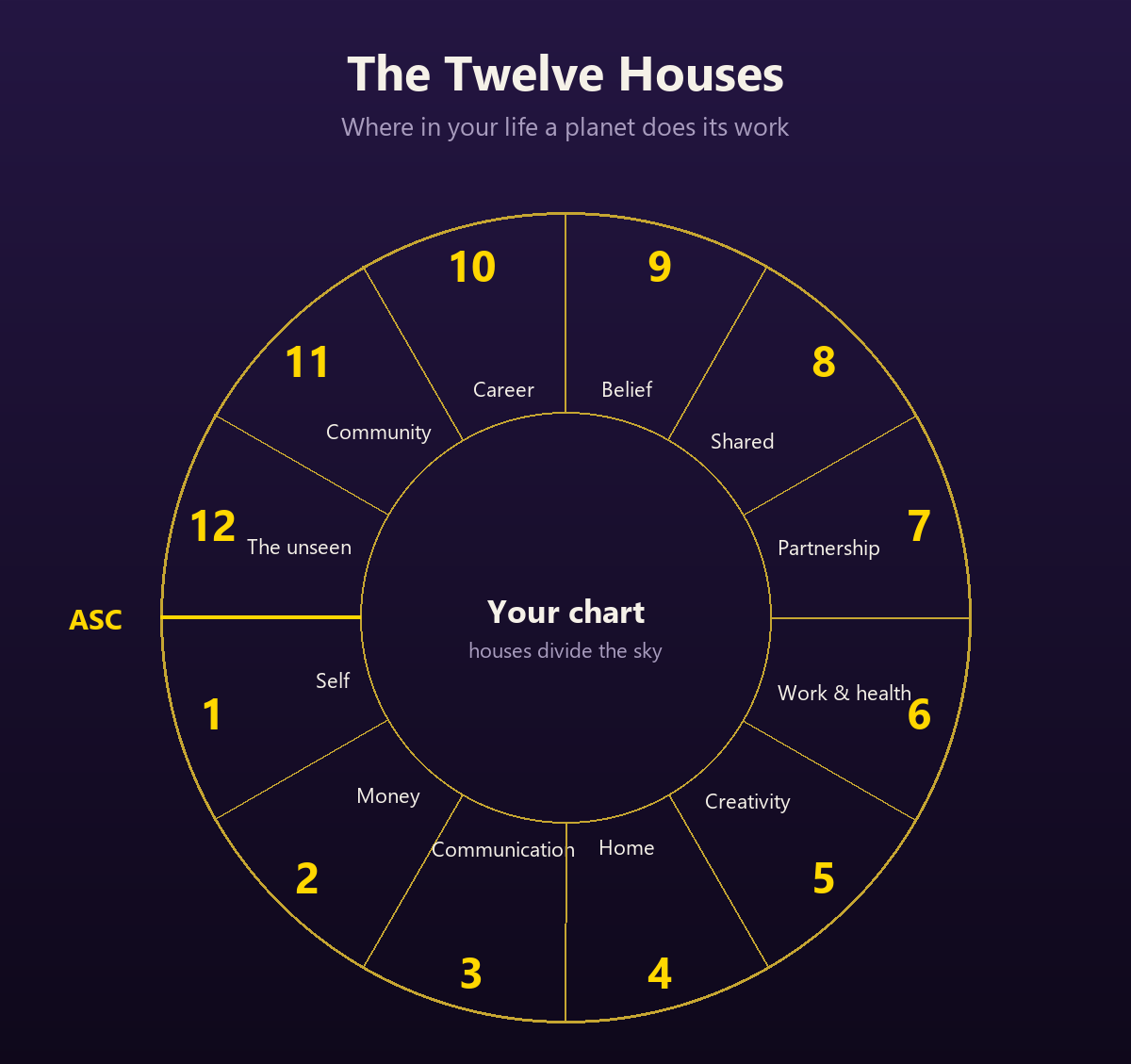
Houses 1 through 4: self, money, communication, home
House 1: self
House 1 begins right where your rising sign sits. It covers your sense of self, how you show up, and the first impression you make before you say a word. Planets sitting here tend to color how the world meets you, right out of the gate, before anyone gets to know the rest of your chart.
House 2: resources
House 2 is resources. Money, yes, but also anything you own or build value in: possessions, skills, talents you could sell, even your sense of what you’re worth. It’s less about whether you’ll be rich and more about how you relate to what’s yours: how you earn it, hold onto it, and whether you feel secure with what you’ve got.
House 3: communication
House 3 is the way you think, talk, and take in information day to day. Siblings, neighbors, short trips, the messages you send, the way your brain processes the world in real time. If house 1 is who you are, house 3 is how you get that self across to everyone else.
House 4: home
House 4 is home. Not just the building, but where you come from: family, roots, the emotional foundation you were raised on, and what home means to you now. It sits at the very bottom of the wheel for a reason. It’s the base the other eleven houses build on.
Here’s why the house matters as much as the sign. Say your chart places Venus, the planet astrology reads as affection and what you value, in house 4. That would suggest your sense of comfort and worth is tied closely to home and family. Move that same Venus into house 2 and the story shifts to valuing security you can hold: money, possessions, material comfort. Put it in house 3 and it might show up as prizing good conversation and close, easy friendships instead. Same planet, three houses, three different chapters of the same life.
Houses 5 through 8: creativity, work, partnership, transformation
House 5: self-expression
Creativity, romance in its lighter dating-and-attraction sense, hobbies, and (in the classic texts) children all live here. Anything you do because you want to, not because you have to, tends to land in house 5. It’s also tied to self-esteem in a specific sense: not how others see you, but how confident you feel putting yourself out there.
House 6: daily work
House 6 is maintenance: routines, habits, the tasks you handle every day, and physical upkeep like diet, sleep, and exercise. If house 5 is where you play, house 6 is where you do the repeated work that keeps everything else running. Day-to-day wellbeing tracks this house more than people expect.
House 7: partnership
House 7 sits directly across the wheel from house 1, and that placement is the point. House 1 is you, alone. House 7 is you in relation to someone else: marriage, a business partner, any committed one-on-one agreement. Older texts file open rivals and formal contracts here too, which comes down to the same theme: anyone you’re bound to by an agreement, good or adversarial.
House 8: shared resources and transformation
You’ll see house 8 called “the house of death” all over the internet, and that’s a scary oversimplification. What it covers is shared resources: combined finances, debt, inheritance, taxes. Other people’s money, as opposed to house 2, which is what you earn on your own. It also covers psychological depth: real intimacy, and the parts of yourself you don’t show casually. Death shows up in the old texts because transformation and endings are cousins, not because this house forecasts anything literal.
Houses 9 through 12: beliefs, reputation, community, the unconscious
House 9: beliefs
House 9 holds religion, philosophy, whatever worldview you’ve built for yourself, plus higher education and long-distance travel. House 3 covers everyday communication; house 9 is that same idea at the widest zoom. Why you think what you think, and where you go looking for more.
House 10: reputation
House 10 is usually called the career house, but reputation is the more accurate word: how the world sees your achievements and standing, not just your job title. This house also gives you the term Midheaven (MC for short), the highest point of the chart at your exact birth moment, sitting at the tip of house 10.
House 11: community
House 11 is friendships, groups, teams, the people you choose instead of the people you’re related to. It also holds your hopes for the future: the goals you work toward alongside other people rather than alone.
House 12: the unconscious
House 12 covers rest, solitude, dreams, and the parts of yourself that stay out of daily view. It’s the least concrete of the twelve, and the most misread. You’ll hear it called the bad house, tied to loss and unseen enemies. That reading is old and fear-based, and modern chart work doesn’t treat it that way. A better translation is hidden, not cursed: your inner world, the patterns you process alone before you’re ready to show anyone. Planets here simply play part of their story out somewhere private.
That’s the full wheel: twelve life areas, each one shaped by whichever planets happen to be sitting inside it. Which brings us to the practical question: where are yours?
In MysticAlmanac, your houses are placed from your exact birth time and place, with every planet already sorted into its wedge, so you can check each of the twelve against your real life tonight.
How to find your houses by hand
If you’d rather work it out yourself on a printed chart, the process is three steps.
Find your Ascendant. That point marks the start of house 1. You need your birth date, exact birth time, and birth place; the time matters most, because the cusps move fast.
Walk the cusps around the wheel. From the Ascendant, the houses follow in order, wrapping all the way back to house 12, which sits right before house 1 begins again.
Place each planet between its two cusps. A planet belongs to whichever house it falls inside. Take a chart with an Ascendant at 9 degrees Aries and a house 12 cusp at 24 degrees Aquarius. A Sun at 24 degrees Pisces sits between those two points, so that Sun lives in house 12: a core identity worked out mostly internally before anything shows on the outside. If a planet lands exactly on a cusp, it belongs to the house that cusp starts.
One more thing worth knowing before you start: an empty house is normal. Most charts have at least one, and it doesn’t mean an empty life area. A loaded house, on the other hand, is worth sitting with. Three planets stacked in one wedge concentrates that life area in a way that stands out the moment you see the wheel.
A house shows you where a theme tends to concentrate in your life, not a fixed outcome you’re locked into. Read the wheel slowly, one wedge at a time, and check each one against how you already live. You’ll probably recognize more than you expect.
Once the houses make sense, the last layer is the aspects between your planets, the lines that connect one wedge to another. Both rungs sit in order, with everything before them, in the full birth chart course.
Common questions
What are the houses in a birth chart?
The houses are twelve wedge-shaped sections of a birth chart, and each one stands for a life area rather than a personality trait: self, money, communication, home, creativity, work, partnership, and so on. Which house a planet falls in shows where that planet's themes tend to play out in your life.
How do I find out which house a planet is in?
Find your Ascendant, which marks the start of house 1, then follow the house cusps around the wheel in order. A planet belongs to whichever house its degree falls in, between the cusp that starts the house and the cusp that starts the next one. You need an exact birth time and place for the houses to be placed correctly.
What does an empty house mean in astrology?
Nothing worrying. Most charts have at least one empty house. It simply means that life area isn't concentrated in a single planetary placement. The sign on the house's cusp still describes how you tend to approach that part of life.
See your twelve houses
Your house cusps calculated from your birth time and place, with every planet already sorted into the wedge it falls in. Seven days free at full Premium.
See my houses →Not ready for that? New lessons go up daily — subscribe on YouTube or follow on TikTok.