What Your Rising Sign Really Says About You
Your rising sign shapes first impressions and frames your whole chart. How to find it, what each of the twelve means, and what to do without a birth time.
If you have ever read your horoscope and thought “that’s not me at all,” your rising sign may be part of the reason. Most horoscopes are written for the sun sign. The rising sign is a different piece of the puzzle, and often a more visible one.
What the rising sign actually is
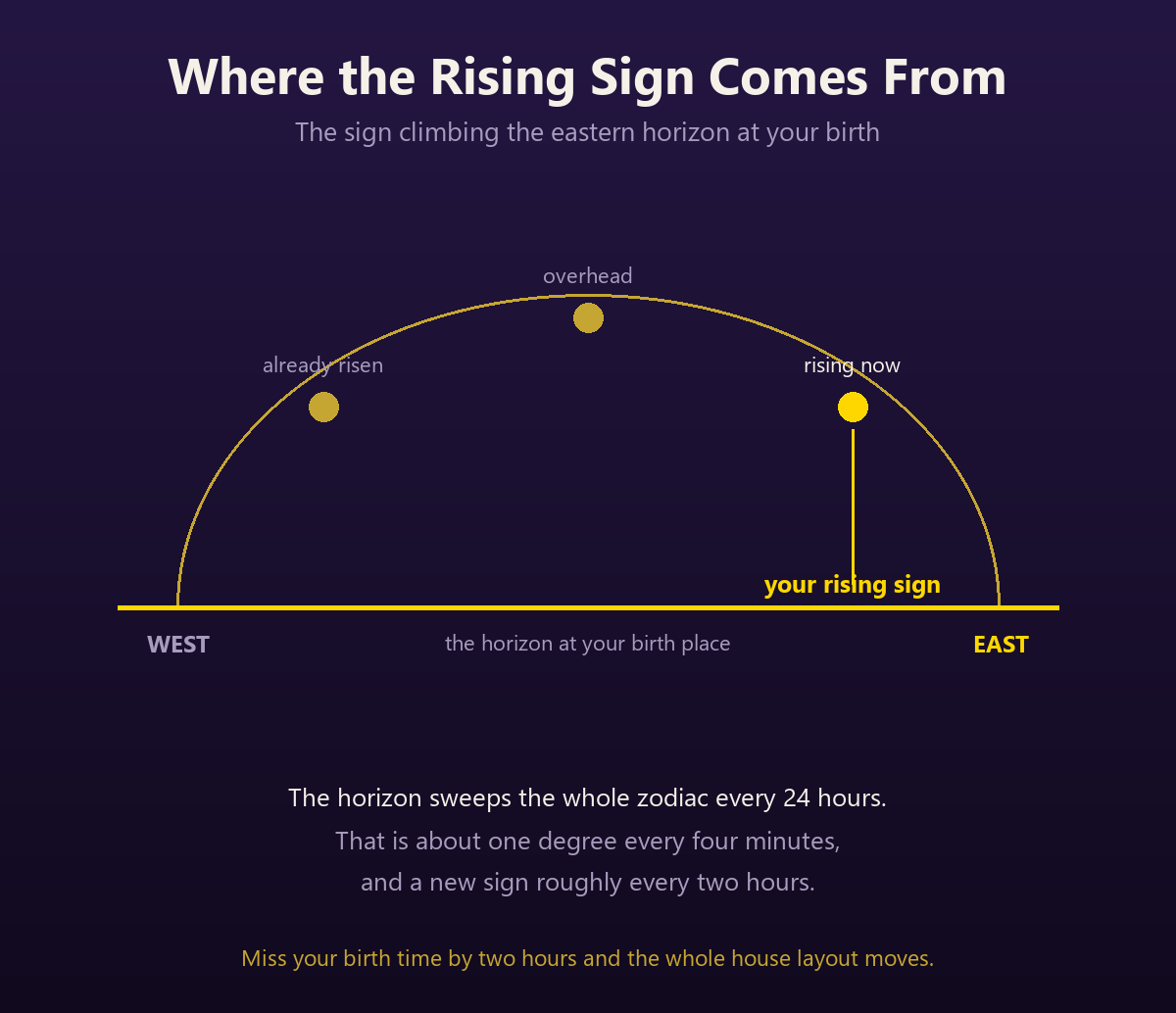
Your rising sign, also called your ascendant, is the zodiac sign that was coming up over the eastern horizon at the exact minute and place you were born. The whole sky appears to rotate once a day, so the ascendant moves about one degree every four minutes and changes sign roughly every two hours. That is why two people born on the same day, in the same city, can come across so differently.
In a birth chart, the ascendant is where the wheel begins. It marks the cusp of the first house and sets the arrangement of all twelve — the life areas your planets fall into. Change the rising sign and every planet in the chart lands in a different house. It shapes how the rest of the chart is read before you read any of it.
Why it’s called the “front door”
Traditionally, the rising sign is read as the instinctive way you meet the world: what people pick up before they know you, how you walk into a new room, the lens your whole chart looks out through. If your sun sign is the engine, your rising sign is the doorway.
None of this is a verdict. It is a mirror, and a starting point for reflection rather than a prediction of how your life will go.
The twelve rising signs, briefly
What each ascendant is traditionally associated with. Read your own, then read the one belonging to someone you know well, because the contrast teaches more than the description does.
- Aries rising — direct, quick to act, meets the room head-on.
- Taurus rising — steady and unhurried, settles into a space rather than entering it.
- Gemini rising — curious and quick-talking, asks questions early.
- Cancer rising — gentle and protective, reads the emotional temperature first.
- Leo rising — warm and visible, comfortable being looked at.
- Virgo rising — observant and precise, notices the detail nobody mentioned.
- Libra rising — considered and courteous, tunes into other people and the feel of a room.
- Scorpio rising — reserved and watchful, gives little away at first.
- Sagittarius rising — open and candid, says the thing directly.
- Capricorn rising — composed and capable, gives an impression of quiet authority.
- Aquarius rising — friendly and slightly apart, observes the group from just outside it.
- Pisces rising — soft-edged and receptive, adapts to the mood around them.
A description that fits loosely is doing its job. The ascendant is a manner, not a personality test.
How to find your rising sign
You need three facts: your birth date, your exact birth time, and your birth place. The time carries the most weight here, because the ascendant shifts every couple of hours and even a thirty-minute error can move you into the wrong sign. Your birth certificate is the most reliable source; hospital records and a parent’s memory of “sometime that evening” are not the same thing.
Given those three facts, any accurately cast chart places your ascendant to the degree, along with the houses it sets in motion.
What if you don’t know your birth time?
This is one of the most common questions about the ascendant, and it deserves a straight answer rather than a workaround.
You cannot calculate a rising sign from a birth date alone. If a calculator hands you one anyway, it has quietly assumed a time — usually noon — and what it returned is noon’s ascendant, not yours. On a given day the horizon moves through all twelve signs, so that answer has about a one-in-twelve chance of being right.
What you can do instead:
- Narrow the field. If you know your birth happened in the morning, or in the evening, that window rules out most of the twelve and often leaves two or three candidates.
- Read the candidates against your life. Ascendant descriptions are about manner and first impressions, which other people can confirm. This is inference, not calculation, and worth holding loosely.
- Look for the record. Many regions list the time on the long-form birth certificate. It is frequently obtainable and settles the question permanently.
- Read the rest of your chart normally. This is the part people miss. Planetary positions by sign barely move over a single day, so your Sun, Moon, and planets in signs are all still valid. What an unknown time costs you is the houses, the ascendant, and the Midheaven — not the whole chart.
Reading it in context
The rising sign works best read alongside the rest of the chart. Sun, Moon, and rising together — your Big Three — give a fuller picture than any one alone: your core, your inner world, and your doorway. The ascendant also pairs directly with the Midheaven, the other angle of the chart, which describes your public and professional face rather than your personal one.
If you want the whole sequence in order, the full birth chart course puts the rising sign on its proper rung: after what a chart is, before the houses it frames.
In MysticAlmanac, your rising sign is placed from your exact birth time, and the Guided Tour walks you through it one card at a time, so you learn why your ascendant is what it is rather than just what it is called.
Your chart is meant to be read slowly. Start with the door, then step inside.
Common questions
What is a rising sign?
Your rising sign, or ascendant, is the zodiac sign that was climbing over the eastern horizon at the exact moment you were born. It sets the layout of your chart's houses and is traditionally read as the 'front door' of your personality.
Do I need my exact birth time to know my rising sign?
Yes. The ascendant moves through roughly one degree every four minutes and changes sign about every two hours, so an accurate rising sign needs your birth time. Without it, the sign can only be narrowed to a range.
Can I find my rising sign without a birth time?
Not reliably. Any calculator that returns a rising sign from your date alone is defaulting to a fixed time, usually noon, and the result is that assumed time's ascendant rather than yours. You can narrow the possibilities to two or three signs, and the rest of your chart still reads normally.
Is a rising sign the same as a sun sign?
No. Your sun sign is where the Sun was on your birthday; your rising sign is set by the time and place of birth. Many people feel their rising sign describes how others first see them, while the sun sign describes their inner drive.
Find your rising sign
Enter your birth date, time, and place, and your ascendant is placed to the degree — with a guided tour that walks you through the houses it sets up. Seven days free at full Premium.
Calculate my rising sign →Not ready for that? New lessons go up daily — subscribe on YouTube or follow on TikTok.