Midheaven and Ascendant: The Two Chart Angles Explained
The Midheaven and Ascendant are really two axes, four points, set by your exact birth time and place. Learn what each angle does and how to find all four.
Two points in your chart tell you how you meet the world and where you’re trying to get in it. Neither one is a planet. Your Midheaven and Ascendant come from the clock and the map, the exact minute and the exact place you were born, and they shift faster than anything else on your wheel. That speed makes them the two points least likely to match anyone else’s chart. Here’s what each one does, why they’re really two axes rather than two lone points, and how to find all four ends in your own chart.
Where the two points sit
Picture the moment you were born as a snapshot of the sky around one spot on Earth. Two lines cut across that snapshot. One runs along the horizon, where the sky meets the ground to your east and west. The other runs from straight overhead down to the ground beneath your feet.
Your Ascendant is the point where the eastern horizon crosses the zodiac, the sign coming up as you were born. If the term is new to you, the rising sign has the full treatment; here it’s enough that the Ascendant sets the start of house one. Your Midheaven is the point at the very top, the highest the zodiac climbs over your birthplace at that minute.
Neither point is a body in the sky. There’s no Midheaven planet to look up. Both are geometry: the meeting of the zodiac with the horizon and with the overhead line, calculated from when and where you were born.
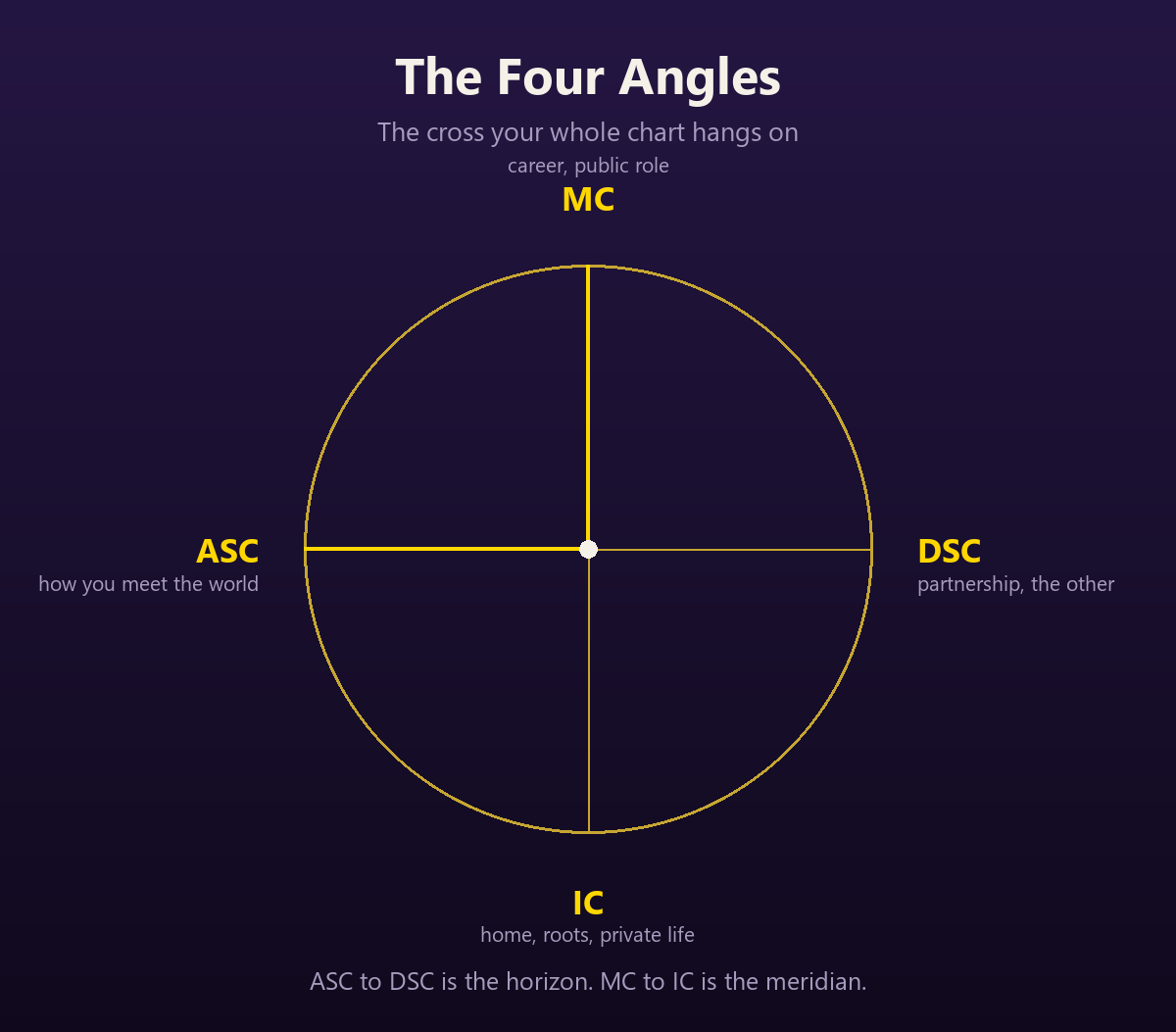
Two lines, four points
Here’s the part most descriptions leave out. Each of those two points has an opposite end, so you’re really working with four.
The Ascendant, on the eastern horizon, is paired with the Descendant on the western one. The Midheaven, at the top, is paired with the point at the bottom, called the Imum Coeli, or I-C for short. Two lines, four ends. That cross is what your whole chart is built around.
The self-and-others axis
The horizon line, Ascendant across to Descendant, is your self-and-others axis.
Your Ascendant, the start of house one, is how you meet the world: your instinct on the way in, the first move you make in a new room, the version of you people get before they know you. Its opposite, the Descendant, is what you look for in other people. The qualities you don’t feel in yourself and reach for in a partner sit there.
The public-and-private axis
The vertical line, Midheaven down to the I-C, is your public-and-private axis.
Your Midheaven, the point that caps house ten, is where you’re headed in the eyes of the world: your direction, your reputation, the thing people attach to your name. It’s wider than a job title. It’s what you’re building toward out in the open. Its opposite at the base, the I-C, is your private root: home, family, where you come from, the ground you return to when the public part switches off.
That framing changes how you use the chart. A single point invites a single label. An axis invites a tension you can watch in your own life: the pull between how you show up and what you seek in others, or between the public climb and the private ground it rests on. The four ends only make sense read in pairs.
Where quick takes shrink it
A lot of short summaries reduce the Ascendant to your looks and the Midheaven to your career. Both reads are too small. Your Ascendant is your whole approach to being alive, not your face. Your Midheaven is a public direction, not the box on a tax form. Read them as two axes that point the chart, not two more personality labels.
All four angles on a real chart
Take a real example: Maya, born at 6:42 in the morning in Chicago.
Her Ascendant is 9 degrees Aries. Directly across, her Descendant is 9 degrees Libra. So she meets the world the Aries way, first through the door, direct, quick to start. And she’s drawn toward Libra qualities in a partner: balance, fairness, the person who weighs both sides. The approach and its counterweight, sitting on one line.
Her Midheaven is 4 degrees Capricorn. Across from it, her I-C is 4 degrees Cancer. A Capricorn Midheaven reads as a public direction built the long way, through structure and earned standing rather than a shortcut. A Cancer I-C puts her private root in home and family, a felt sense of where she belongs. Public climb at the top, family ground at the base. That’s the vertical line of her chart in one picture.
Notice what those four points just did. Before reading a single planet, they sketched her: how she comes in, who she reaches for, where she’s aiming, and what she calls home. That’s the work the angles do. They set the four corners, and every planet gets read inside that frame.
You can run the same read on your own wheel. MysticAlmanac casts your chart from your birth details and marks all four angle points, so you can trace both axes on your own data instead of an example.
How to read your own
Find your Ascendant and Midheaven on your chart, then look at their opposite ends too. The Descendant sits exactly across the wheel from the Ascendant, at the cusp of house seven. The I-C sits exactly across from the Midheaven, at the cusp of house four. If the house layout is fuzzy, the houses guide maps all twelve.
Then read them as two questions, not four labels. On the horizon line: how do you meet the world, and who are you drawn to? On the vertical line: what are you building in public, and what do you call home? The sign on each end colors the answer, the way Aries colored Maya’s entrance and Capricorn colored her climb.
Why exact birth time and place matter here
This is why your exact birth time and place matter more here than anywhere else in the chart. Your planets barely notice a rounded birth time. But these four points are pinned to the spinning Earth, so they race. Fifteen minutes on the clock, or a birth in a different city, can slide your Ascendant and Midheaven into the next sign.
A chart built from your exact minute and exact spot fills all four points in. A guessed birth time leaves the part of the wheel that’s uniquely yours blurry. If you know your birth time, this is the piece it unlocks. If you don’t, a birth certificate is usually the fastest way to recover it.
One note on what the angles claim. These four points describe how you tend to meet the world and where you tend to aim. They don’t fix what happens to you. A birth chart is a mirror for self-reflection, not a prophecy, and what you do with your approach and your direction stays yours.
The frame in one picture
Two lines, four points. The horizon carries your Ascendant and Descendant, how you meet the world and who you’re drawn to. The vertical line carries your Midheaven and I-C, your public direction and your private root. They come from your exact time and place, and they set the frame every planet gets read inside.
Common questions
What is the difference between the Midheaven and the Ascendant?
The Ascendant is the zodiac point rising on the eastern horizon at your birth, and it describes how you meet the world. The Midheaven is the highest point the zodiac reaches overhead at that same minute, and it describes your public direction: reputation, aims, what people attach to your name.
How do I find my Midheaven and Ascendant?
Cast a birth chart from your exact date, time, and place of birth. The Ascendant sits at the cusp of house one, on the left of the wheel, and the Midheaven caps house ten, near the top. Their opposite points, the Descendant and the Imum Coeli, sit directly across from each one.
Why does birth time matter so much for the Midheaven and Ascendant?
The angles are pinned to the spinning Earth, so they move faster than anything else in a chart. Fifteen minutes on the clock, or a birth in a different city, can slide both points into the next sign. Planets barely notice a rounded birth time; the angles do.
Find your Midheaven and Ascendant
Both angles placed to the degree from your exact birth time and location, with the houses they frame laid out around them. Seven days free at full Premium.
Find my angles →Not ready for that? New lessons go up daily — subscribe on YouTube or follow on TikTok.