Birth Chart App or Calculator: Reading It Is the Hard Part
Any birth chart calculator returns the same degrees. The hard part is reading them. How an astrology app turns exact placements into answers you can use.
Type your birth details into any birth chart calculator and you get a wheel. Type them into another one and you get the same wheel. The degrees match, the signs match, the houses match, because planetary positions are astronomy. They are computed from an ephemeris, a table of where every body in the solar system sat at any moment, and that answer does not change based on which site you asked.
So the calculation was never the problem. The problem starts the moment the wheel appears and you are looking at forty symbols you cannot read. That is the gap between a calculator and an app worth keeping: not whether the numbers are right, but whether anything helps you understand what they say about you.
People pay a professional astrologer hundreds of dollars per sitting for exactly that second step. Not to compute the chart. To read it.
What the calculation does, briefly
Worth knowing what happens under the surface, because it explains what a chart can and cannot tell you.
You hand over three facts. Your date places the Sun and roughly places the slower planets. Your time fixes the Moon, which crosses a whole sign in about two and a half days, and sets your rising sign, which moves a full degree about every four minutes. Your place supplies the latitude that shapes the houses and the longitude that converts your local birth time to universal time before anything else runs.
The software then queries the ephemeris and returns your placements to the degree. The full calculation, step by step walks the whole chain if you want to see it worked through.
That is the whole first job, and it is solved arithmetic. The second job is where a chart becomes useful or stays decorative.
Interpretation is the product
“Moon at 25 degrees of Cancer in the fourth house” is a correct sentence and a useless one, until something translates it. What does that placement do? How does it sit with your Sun? Which of the forty symbols on your wheel deserves your attention first?
A raw calculator leaves you to answer those alone, which in practice means a search spiral across contradictory websites, each explaining one placement out of context. A working reading is not a stack of definitions. It is knowing which parts of your chart carry the weight, how they combine, and what that pattern looks like in a life.
This is what MysticAlmanac is built around. The chart tour starts with your strongest aspects rather than a symbol glossary, explains each placement in plain language, and answers in context, the way a sitting with an astrologer would, except it is there every time you have a question rather than once per appointment fee.
The sky keeps moving, and the timing is finer than a day
A birth chart is the frozen frame. The sky itself never stops, and it changes more within one day than most people expect.
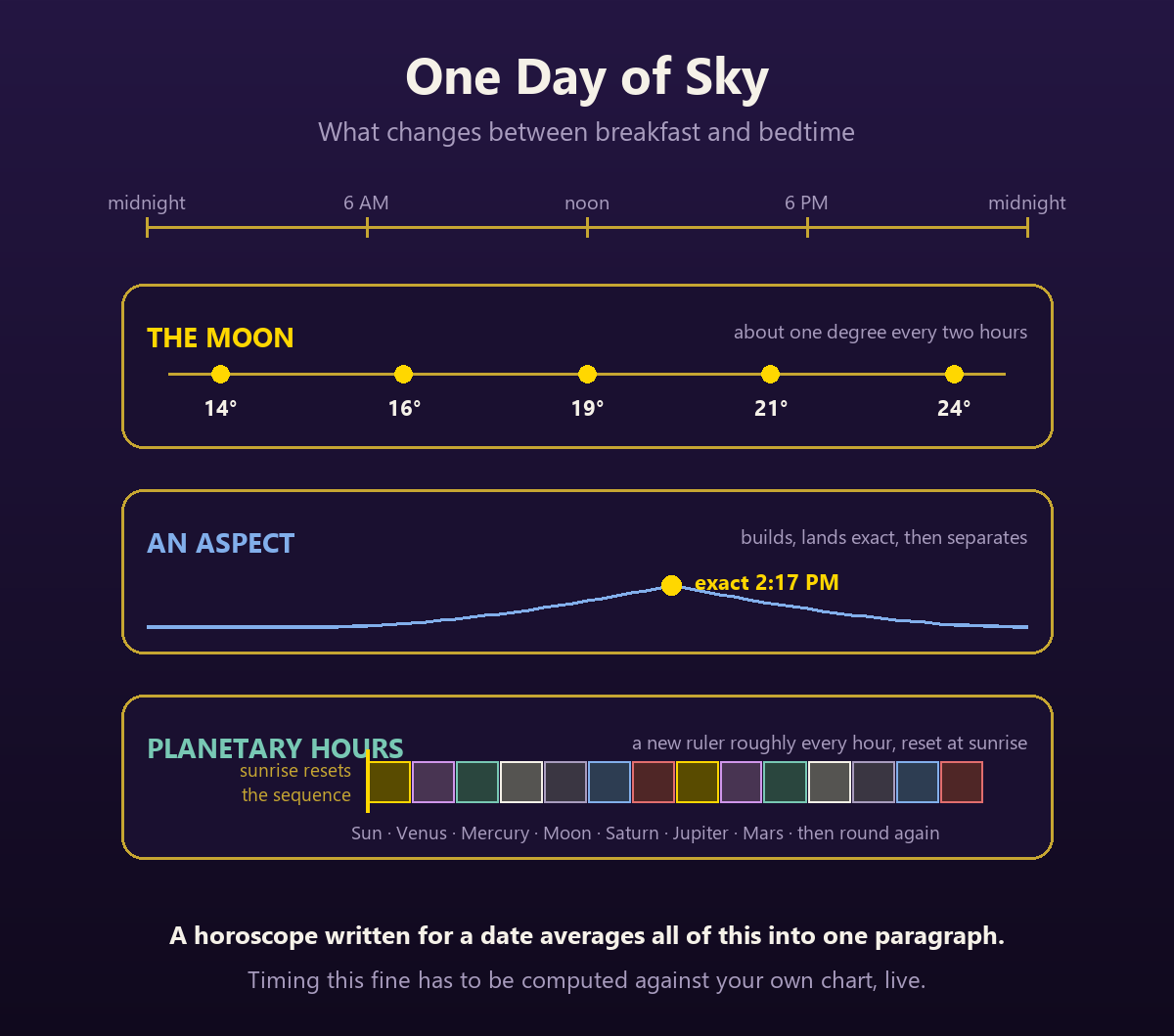
The Moon shifts about a degree every two hours and changes sign roughly every two and a half days, so a morning and an evening of the same date can carry a different tone. Aspects between moving planets perfect at a specific hour, build before it, and separate after it. Planetary hours hand the day from ruler to ruler in a sequence that resets with every sunrise. None of that shows up in a horoscope written for a date, because a date-level forecast has to average the whole day into one paragraph.
Timing this precise only becomes practical when something computes it against your own chart, live. The app tracks the day’s windows, your planetary hours, and how the current sky sits with your placements, so “when” gets as much attention as “what.” For self-reflection and planning, that is the difference between knowing Mercury is retrograde and knowing which hours of your Tuesday carry which flavor.
You can also learn to read it yourself
The chart is yours for life, and reading it is a learnable skill. That is the other half of what we do: The Birth Chart Lab on YouTube teaches the mechanics from zero, one rung at a time, and the full course puts the whole ladder in order. The app gives you the reading on demand; the channel builds the skill so you depend on it less over time. Most people end up using both, checking what they worked out themselves against what the app says.
If you do not know your birth time
You are not locked out. Your Sun, Mercury, Venus, and Mars sit in reliable signs on your date alone, and those cover a great deal of what people come to a chart for.
What you cannot get reliably is a rising sign, and by extension the houses, and the Moon can be uncertain on days it changes sign. The rising sign explainer covers how close you can get by narrowing the possibilities instead of accepting an assumed noon.
What to do with any of it
A chart is not a forecast of what will happen to you. Read it as a mirror: a map of tendencies and patterns you can recognise yourself in, and work with or against as you choose. This is written for insight and reflection, not as advice on money, health, or law.
The calculation matters because a mirror only helps when it shows your own reflection. The interpretation matters because a mirror you cannot read might as well be blank.
Where to go next
If you have never seen your wheel drawn, start with what a birth chart is, then your Big Three, the fastest route from knowing your sign to reading your chart.
The wheel is the easy part. Get it read.
Common questions
What does a birth chart app calculate?
It converts your birth date, time, and place into the exact positions of the Sun, Moon, and planets at that moment, then divides the sky into twelve houses using your birth time and latitude. Everything an app tells you after that is interpretation built on those numbers.
Why do all birth chart calculators give the same result?
Because the positions are astronomy, not opinion. Every proper tool reads the same class of ephemeris data, so your Moon's degree comes out identical everywhere. The calculation is settled; what varies between tools is how well the chart gets explained.
Is there a free birth chart app?
Many apps calculate a basic chart at no cost, and paid tiers usually cover deeper interpretation, transits, and saved charts. MysticAlmanac runs seven days at full Premium with no card required to start.
Can astrology change during the day?
Yes. The Moon moves about a degree every two hours, aspects perfect at specific times, and planetary hours shift rulers throughout the day. A date-level horoscope averages all of that; an app can track the day's windows against your own chart.
Can a birth chart app work without a birth time?
Partly. Planet signs still calculate correctly, so your Sun, Mercury, Venus, and Mars are reliable. Your rising sign and all twelve houses need the time, and the Moon can change sign within a single day. Without a time, work with what the date gives you.
Do I need to give my email to use a birth chart calculator?
For a one-off calculation, often not. For anything that remembers your chart between visits, compares two charts, or tracks the day's sky against your placements, an account is what stores it. MysticAlmanac asks for an email so your chart is there when you come back, and no card to begin.
What is an ephemeris?
A table of where every planet was, is, and will be, computed from astronomical models. Professional astrologers have used ephemerides for centuries. Modern software queries the same data, which is why accurate tools always agree on a planet's degree.
Get your chart read, not just drawn
Your placements come back to the exact degree, and the app walks you through what each one is doing in plain language, any hour you open it. Seven days free at full Premium, no card to start.
Calculate and read my chart →Not ready for that? New lessons go up daily — subscribe on YouTube or follow on TikTok.