Saturn Return Explained: What Happens Around Age 29
Around age 29, Saturn returns to the degree it held at your birth. What a Saturn return is, why it lands at 29 and a half, and how to find your own dates.
If your late twenties felt like a controlled demolition, or you can see one coming, astrology has a name for that stretch: the Saturn return. Around age twenty-nine, Saturn arrives back at the exact spot it held in the sky at the moment you were born. It has a reputation as the roughest scheduled event in a chart. The reputation is half right. What the return does is simpler than the horror stories, and far more useful.
What a return is
A return is exactly what it sounds like. Every planet in your birth chart is frozen at a precise degree, a snapshot from the moment of your birth. The real planets never stopped moving. When one of them travels the full circle and lands back on its own birth degree, that’s a return. The Sun does it every year, on or near your birthday. Saturn takes the long way around.
The moving planet crossing your fixed chart is called a transit: the live sky interacting with your natal snapshot. The Saturn return is the most famous transit in astrology, and once you see how it works mechanically, the fear around it loses most of its grip.
Why it lands at twenty-nine and a half
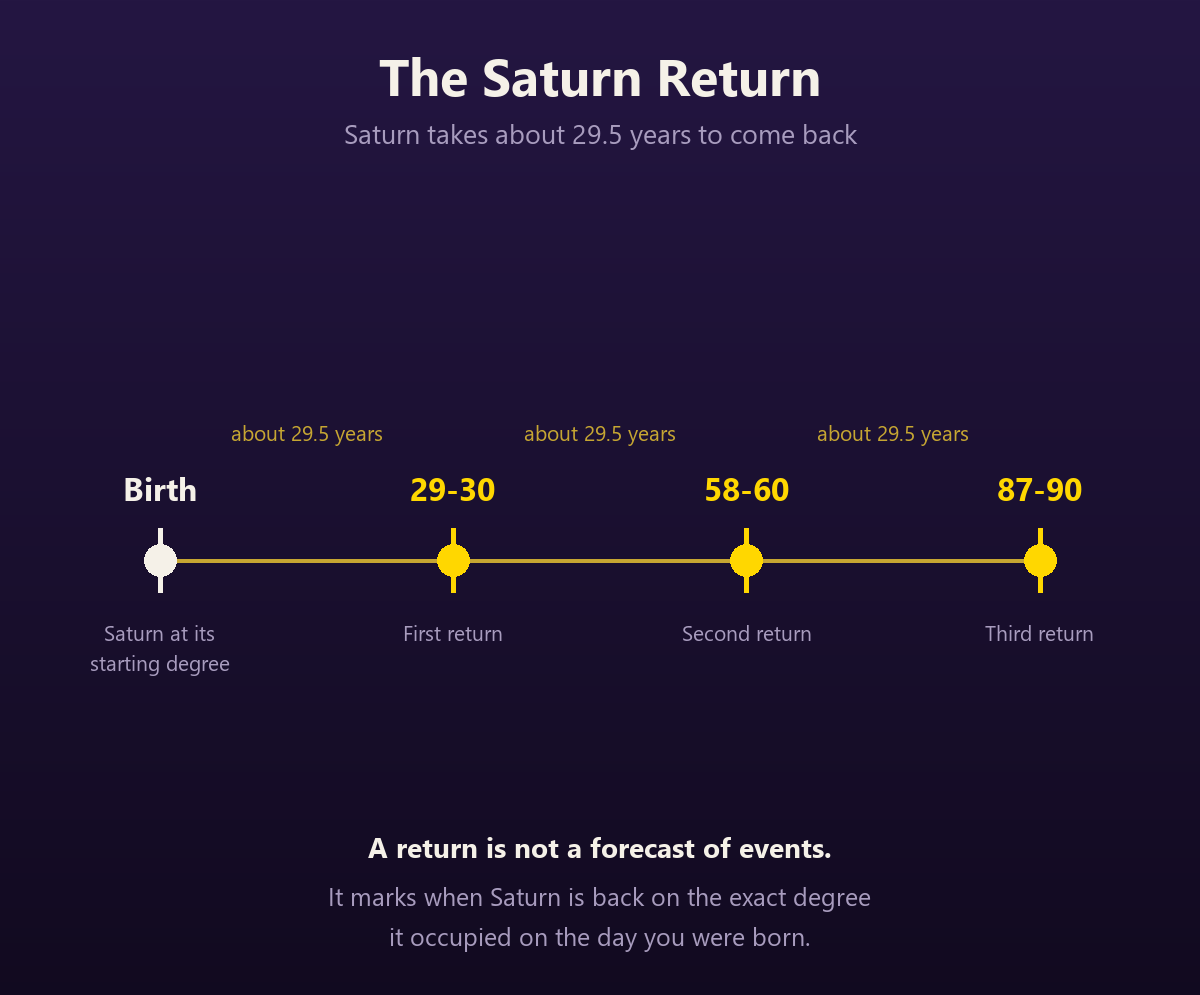
Saturn needs about twenty-nine and a half years for one full lap around the Sun. That single number explains why your late twenties have a reputation. Saturn reaches its birth degree for the first time when you’re twenty-eight or twenty-nine, no matter who you are or what you’re doing with your life.
The season is wider than the exact hit. It opens as Saturn enters the sign your natal Saturn occupies and closes as it leaves, which stretches the whole experience across roughly ages twenty-seven to thirty-one. Think of it as a window, not an appointment.
One pass or three
Inside that window, the exact hit can land more than once. For about four and a half months of every year, Saturn appears to move backward through the zodiac. That’s the retrograde, the same apparent reversal you already know from Mercury, just on a slower clock.
Because of it, a common pattern looks like this: Saturn crosses your birth degree, stations, retraces back over it, then turns around and crosses a final time. Three passes, spread across most of a year. Astrologers often read the sequence as a conversation. The first pass raises the question. The backward pass makes you sit with it. The last one settles it.
Not everyone gets three. Take Maya, an example chart with Saturn at fourteen degrees Aquarius. In May 2021, transiting Saturn climbed to thirteen degrees Aquarius, stationed less than one degree short of her return, and backed away without touching it. A near miss. Then it turned direct, came back, and crossed her birth degree once, cleanly, in late January 2022, a few weeks before she turned thirty. One pass, not three. Every chart makes that kind of choice, and the only way to know which version you got, or will get, is to look at the real dates.
What the tradition says it does
Saturn’s traditional territory is structure: commitments, consequences, the load-bearing walls of a life. When it comes home to its birth degree, the tradition says it leans its full weight on everything you’re standing on. The career you drifted into. The relationship that’s been coasting. The version of adulthood you copied because it was nearest.
Whatever was built to hold, holds, and becomes more solid and more yours. Whatever was propped up starts to buckle. That’s why Saturn-return stories sound like endings and commitments at the same time: quitting, marrying, moving, finishing the degree, leaving the hometown. In the traditional reading, the return doesn’t wreck a life. It audits one.
That’s worth sitting with, because it’s the opposite of the doom framing. An audit isn’t an attack. It’s a review, and the things in your life that fit you pass it.
First return, second return, third
The audit changes with age. The first return, around twenty-nine, asks whose life this is. It’s the deadline on borrowed structure, and what you build in answer tends to carry you for decades. The second return lands around fifty-eight or fifty-nine and asks a different question: what still matters. Work heads into its final act, kids leave, and Saturn weighs what you’re carrying into the years ahead. Live to about eighty-eight and a third one comes around. Same planet, same math, a new question each lap.
The season versus the hit
One distinction saves a lot of worry: the difference between the season and the exact hit. The exact hit is Saturn sitting on your natal degree, and it’s brief. The season is the years-long stretch when Saturn moves through your natal Saturn sign, approaching and departing. Most of what people call “my Saturn return” happens across the season, not on the day of the crossing.
That framing matters because it removes the trapdoor feeling. Nothing springs on you at a single moment. The themes build gradually as Saturn closes in, peak around the passes, and ease off as it moves on. If you know your dates, you can watch the whole arc form in advance instead of naming it years later in hindsight.
Where the return lands in your chart adds another layer. Your natal Saturn sits in one of the twelve houses, the life areas of the chart, and the tradition reads the return’s themes through that house. Saturn in the house of career keeps the audit professional. Saturn in the house of partnership turns it toward commitments between people. Same cycle, different room of the life. That’s a deeper read than this piece needs, but it’s the natural next question once you know your dates.
How to find your own dates
Finding yours takes two facts. First, your natal Saturn: the sign and degree it held at your birth, sitting in your chart alongside your Sun, Moon, and rising. Second, where Saturn is now relative to that spot. If you were born roughly twenty-seven to thirty-one years ago, or fifty-six to sixty, you’re either in the season or close enough to watch it form. Pull up your chart, find the Saturn glyph, and write down its degree. That one number turns the most feared transit in word-of-mouth astrology into a date you can prepare for.
You can see your natal Saturn placed from your exact birth details in MysticAlmanac, alongside the rest of your chart, so the degree you write down is computed rather than guessed.
Reading it without the doom
A Saturn return marks when the questions get loud. It doesn’t choose your answers, and it doesn’t lock in an outcome. The chart works best as a mirror held up to where you stand, not a verdict handed down. And when the stakes are real, a career, a marriage, your health or money, use it for reflection alongside qualified advice, never instead of it.
The short version: Saturn circles the Sun in about twenty-nine and a half years, so near twenty-nine it comes back to its own birth degree in your chart. The season runs a few years, the exact hit comes one to three times, and the tradition reads it as a stress test of whatever your life is built on. First return: build something that’s yours. Second: decide what stays. Both run on a schedule you can look up tonight. Saturn’s other cycle is far shorter and arrives for everyone at once: Saturn retrograde 2026 runs from July 26 to December 11, and the two get confused constantly. Saturn is not the only cycle that works this way: the same slow-planet arithmetic applied to world events gives you the Barbault basket of 2026.
Common questions
What is a Saturn return?
A Saturn return is the point when Saturn, moving through the sky, arrives back at the exact degree it held in your birth chart. Because Saturn takes about 29.5 years to circle the Sun, the first return lands around age 29, with a wider season running roughly ages 27 to 31.
At what ages does a Saturn return happen?
The first Saturn return lands around age 28 to 29, inside a season of roughly 27 to 31. The second comes around 58 to 59, and a third around age 88 for those who live to see it.
Is a Saturn return bad?
Tradition doesn't read it as punishment. Astrologers describe it as a review of the structures you've built: commitments that fit tend to deepen, and ones that never fit come up for renegotiation. It's a season for reflection, not a fixed verdict on your life.
Find your Saturn return dates
Your Saturn placed to the degree, and the years it returns to it, calculated from your own chart rather than the age-29 rule of thumb. Seven days free at full Premium.
Find my Saturn return →Not ready for that? New lessons go up daily — subscribe on YouTube or follow on TikTok.