Master Numbers 11, 22, 33: Why They Never Reduce
Numerology reduces almost every number to one digit except 11, 22, and 33. Here is the exact rule for when a master number holds, plus how to check your own.
Master numbers are the three totals numerology refuses to reduce: 11, 22, and 33. Every other number in the system gets walked down to a single digit by adding its digits together. These three get held exactly as they are. If your Life Path lands on one of them, numerology reads you differently from everyone else, and most people have never checked whether one is theirs. This post gives the exact rule for when a number holds as a master number, when it collapses to a single digit instead, and how to run the check on your own birth date.
The rule: three totals that halt the reduction
Start with the move the rest of numerology is built on. Reducing means adding a number’s digits together until a single digit is left. Thirty-four goes to seven (3 + 4) and stops there, one digit, done. Forty-eight goes to twelve, and twelve goes to three. Almost every number in numerology gets walked down that way, one addition at a time, until it sits between one and nine.
There are three exceptions. When your adding lands on 11, 22, or 33, you halt. You hold that two-digit number instead of reducing it any further. Thirty-eight adds to eleven, and eleven is where you stop, not the two it would otherwise fold into. Those three totals are the only ones in the whole system you leave standing.
That halt is the entire definition. A master number isn’t a special category you get assigned; it’s a place where the arithmetic stops early. Which means you can’t decide to have one, and you can’t be talked into one by a reading that skips the math. Either your digits land there or they don’t, and anyone adding the same date lands on the same answer.
One boundary worth stating plainly: the halt happens at a reduction step, the moment an addition produces its total. A total merely passing through on its way somewhere else doesn’t trigger it, and neither does a number that simply looks like an 11 on the page. Both of those distinctions get tested below.
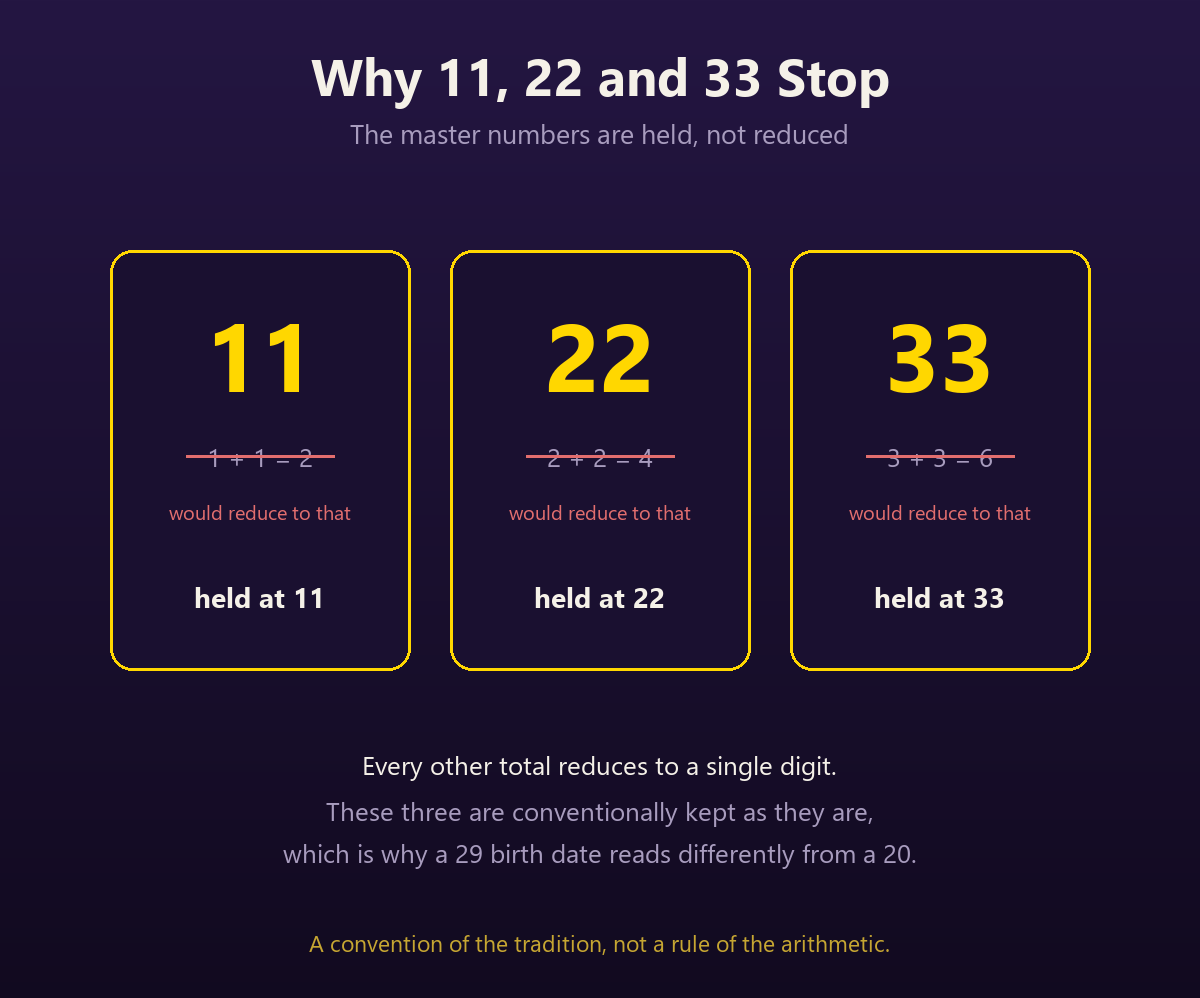
Why 11, 22, and 33, and not other numbers
Look at what the three have in common. Each one is a doubled digit: one and one, two and two, three and three. And each still has a single-digit root underneath, the digit it would reduce to if you took one more step. Eleven reduces to two, twenty-two to four, thirty-three to six.
A master number gets read as both at once. Numerologists even write them showing both numbers: eleven with a two, twenty-two with a four, thirty-three with a six. The notation is a reminder that a master number sits on top of an ordinary root it never fully leaves behind. It carries the plain meaning of that root, turned up to a higher demand, with more to live up to.
Finding one in a real Life Path
Your Life Path number is your full birth date, reduced all the way down. It’s the foundational number the whole tradition anchors on, and it’s where master numbers most often turn up. If Life Path calculation is new territory, the Life Path number post works the full method; here we only need enough of it to catch a master number in the act.
Take Nora, born September 1st, 1990, a worked example rather than a real person. Write her date as a straight row of digits and add them:
0 + 9 + 0 + 1 + 1 + 9 + 9 + 0 = 29
Reduce twenty-nine: 2 + 9 = 11. Normally you’d take one more step down to a two. Here you don’t. Eleven is a master number, so it holds, and Nora’s Life Path is 11.
The component method lands in the same place. September is nine. The day is one. The year 1990 reduces through nineteen down to one (1 + 9 + 9 + 0 = 19, then 1 + 9 = 10, then 1 + 0 = 1). Nine plus one plus one is eleven. Same answer, either road, which is the mark of a calculation done right.
You can run the same check on your own date in under a minute, or let MysticAlmanac work your full numerology profile alongside your birth chart from the same details.
The mistake: a visible 11 is not a master number
Here’s where people slip. A master number has to be a total you land on by adding. Not any eleven you happen to spot inside a date.
Someone born in 2011 has an eleven sitting right there in the year. On its own, it does nothing. Reduce two thousand eleven the normal way, 2 + 0 + 1 + 1, and you get four. That visible eleven never counted, because it was never the result of a reduction step. The rule cares about where the arithmetic lands, not what the date looks like on paper.
22 and 33 follow the same rule
The other two behave identically. Land on twenty-two by adding, and you hold a twenty-two, sitting over its root of four. Land on thirty-three, and you hold it over a six. Thirty-three is the rare one. A birth date’s digits have to total exactly the right amount to reach it, so it turns up far less often than eleven.
Where master numbers apply, and where they don’t
One more piece, so you read your own numbers correctly. The hold-instead-of-reduce exception belongs to your foundational numbers: the ones built once from your full birth date or birth name, like your Life Path.
The rolling cycle numbers work differently. Your Personal Year, Personal Month, and Personal Day get reduced all the way to a single digit every time, which is why a Personal Day calculation ends on a plain digit rather than an 11 or a 22. The reasoning most numerologists give is that a master number asks too much to carry every single day. It suits the parts of your numerology that hold still for a lifetime, not the ones that turn over at midnight.
So the two halves of the tradition stay consistent. Foundational numbers can hold a master number. Cycle numbers always walk down to one digit. If a daily calculation ever seems to end on an eleven, keep reducing; that chain wasn’t built to stop there.
Run your own check
Write your birth date as one row of digits, add them all, and reduce. If your adding stops on 11, 22, or 33 before you reach a single digit, that one is yours to hold. If it walks all the way down to a single digit, that digit is your Life Path, and it’s no smaller for reducing. The single digits carry the tradition’s core meanings; the master numbers are a rarer variation, not a ranking.
Read a master number the way you’d read any part of a chart: a mirror for self-reflection, something to notice about how you’re built. The arithmetic tells you which number is yours. What you do with that is still yours too.
Common questions
What are the master numbers in numerology?
The master numbers are 11, 22, and 33. They are the only totals in numerology that are held as two-digit numbers instead of being reduced to a single digit. Each one is a doubled digit sitting over a single-digit root: 11 over 2, 22 over 4, and 33 over 6.
How do I know if my Life Path is a master number?
Write your full birth date as a row of digits and add them, reducing as you go. If the adding lands on 11, 22, or 33 at a reduction step, you stop there and hold it as your Life Path. If it walks all the way down to a single digit, that single digit is your Life Path.
Is having an 11 in my birth year a master number?
No. A master number has to be a total you land on by adding. An 11 that is simply visible inside a date, like the year 2011, does nothing on its own. 2011 reduces normally: 2+0+1+1 = 4.
Check whether you carry a master number
Your Life Path calculated with 11, 22, and 33 held apart rather than reduced away, so you can see exactly where yours lands. Seven days free at full Premium.
Check my number →Not ready for that? New lessons go up daily — subscribe on YouTube or follow on TikTok.